
Francesco Molino
Nouvelle Méthode 1813
Molino’s guitar method is the last one we shall look at in this article. The method, which is in both french and german, is quite thorought with an introduction to the principles of music and basic playing instructions. A big emphasis is put on arpeggios and accompaniment. On page 35 he writes:
Dans les Gammes d’Ut majeur et La mineur, on trouvera écrit dans toutes les mesures des petites notes, qui ne doivent pas se pincer, mais qui sont là seulement pour indiquer l’harmonie entiere, et propre à chaqu’ accord donné, ainsi qu’il a été dit dans la règle générale.
In the Scales of C major and A minor, one will find small notes written in all of the measures, which should not be plucked, but which are there only to indicate the whole harmony, proper to each given chord, as it was said in the general rule.
The règle générale is most likely Molino’s term for the Rule of the octave. When analysing the chords we shall see that Molino’s instructions are similar to the common RO.
Comment
One thing that sets Molino apart from Kirkman and Doisy is the inclusion of the small notes. These show us the chord which the arpeggiated figure is based on, and how to approach the chord in an guitaristic manner. As an example, see ➃ – this scale degree includes the 3, 5 and 6. But playing the 5 and the 6 would be very difficult since both usually are played on the same string. To accomodate for this Molino cut the 5 out of the figure, making it easier to play but keep’s the fundamental harmony. By doing that he also indirectly tells us that when playing partimenti where this problem occurs, the player can choose to exclude the 5 if it facilitates the playing.
Molino’s harmonisation of the major scale
We can see a lot of similarities to the previous composers, but contrary to the earlier examples the author chooses to stay in the first position throughout the complete scale. By making this choice the bass line needs to be transposed an octave lower at some point, and discontinues the usually stepwise scale.
Fig. 13
Gamme harmonique ou d’accompagnement / Harmonische oder begleitete Tonleiter from Nouvelle Méthode.
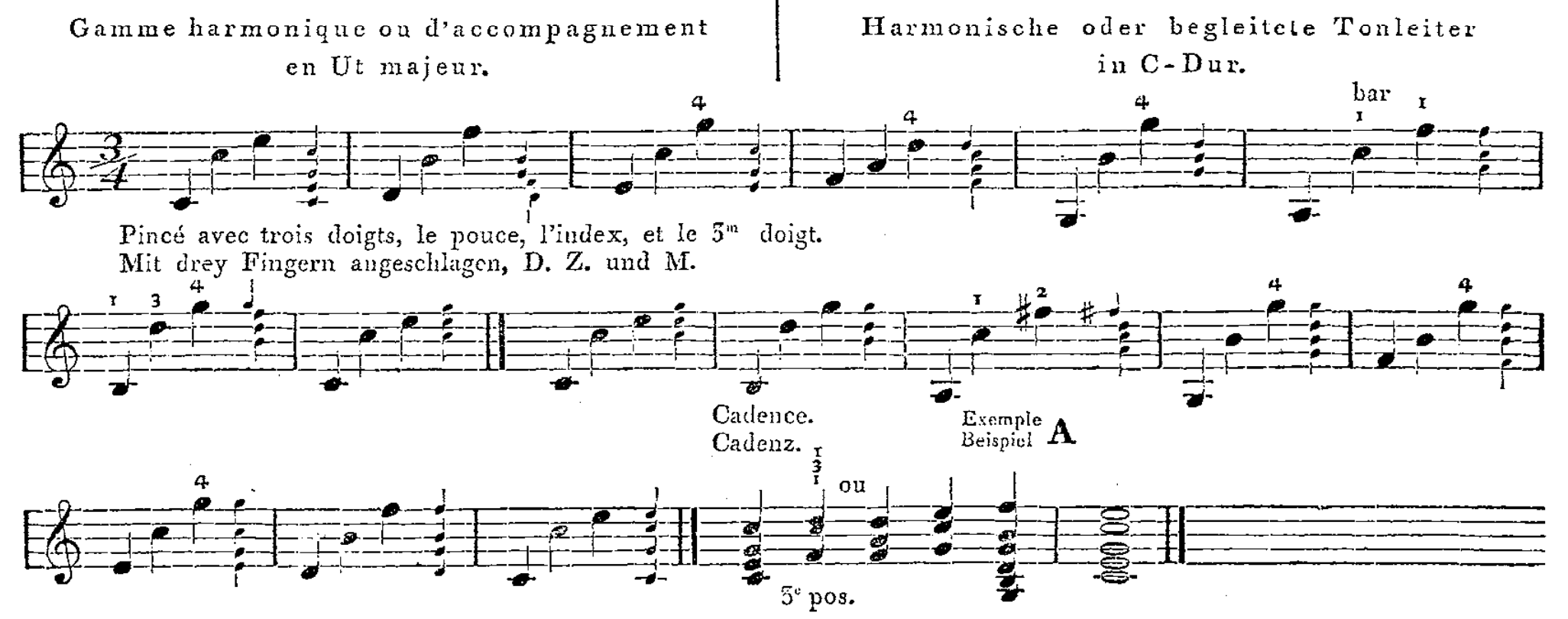
Like the earlier mentioned exlusion of the 5, this is also a good example on how to facilitate for the guitarist with a more idiomatic approach. Seldom do the guitar music of the 19th century include dense chords in high positions, but is rather filled with common chord shapes and open basses.
Molino’s harmonisation of the minor scale
Molino uses the same principle as the other authors, but with some variations.
➃ when ascending – can be seen as a sixth chord, or an inversion of ➁. When descending – an inversion of ➄.
➅ when ascending – Molino uses the same principle as the other authors, with the exception of the ascending ➅. Contrary to Doisy, Molino does not include the 6#, but instead uses the 6♮. This gives the scale degree a neutral sound, and does not have the same pull towards ➀ as when the 6# is used.
➅ when descending – natural (♮) with a 6#. This harmonisation is similar to that of Kirkman.
Fig. 14
Gamme harmonique ou d’accompagnement / Harmonische oder begleitete Tonleiter from Nouvelle Méthode.

Molino’s version of the RO is a fine example of how to approach harmony on the guitar, with some accessible instructions suitable for most performers.
Fig. 15
Gamme harmonique ou d’accompagnement / Harmonische oder begleitete Tonleiter by Franscesco Molini notated in partimento style.

Fig. 16
Gamme harmonique ou d’accompagnement / Harmonische oder begleitete Tonleiter by Franscesco Molino notated in partimento style.
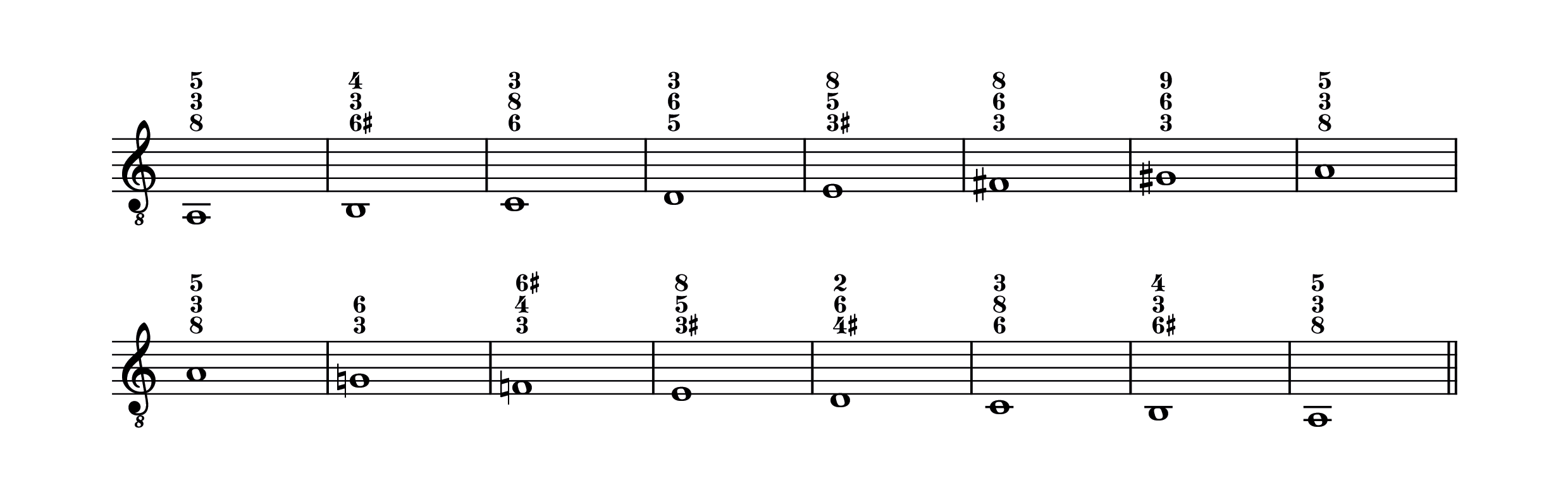
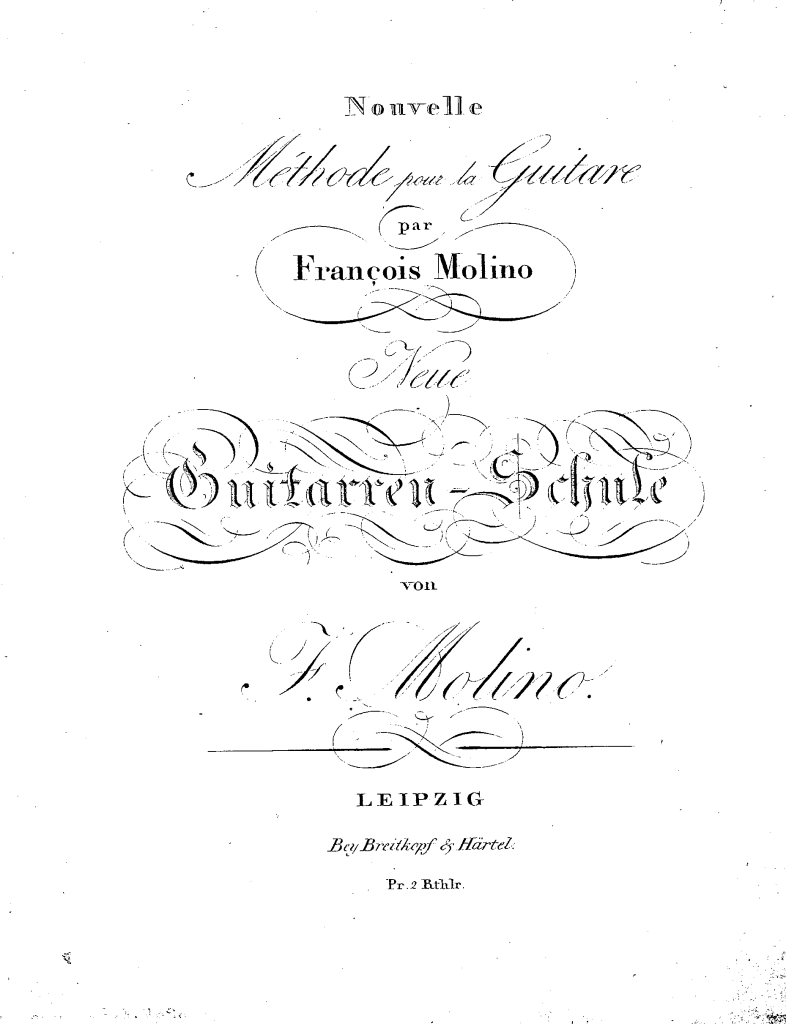
Molino’s Gammes Harmoniques can be found on the pages 35-59 in his Nouvelle Methode pour la Guitare.
This concludes our exploration of the Rule of the Octave. To reinforce your understanding, a couple of practice exercises are available here. These are designed to help internalize the patterns and principles discussed throughout the article. In the future, I plan to expand this collection with additional examples and varied harmonic contexts, offering a broader range of material for study and application. Stay tuned for updates as this resource continues to grow.
 Karl Michelson