
Lousia Kirkman
Improved method for the guitar c. 1830-33
Around 1831-33 Louisa Kirkman published her Improved Method for the Guitar, designed to facilitate the progress of the pupil and to diminish the labour of the teacher containing a detalied overview of the RO in all of the 24 major and minor keys. In her method we find the inclusion of both the ascending and descending scale, and at the end of the descending minor scale a reharmonisation of the first scale degree with an added 7th is introduced to serve as a passing dominant, making a pleasant transition to the consecutive major key.
As we look closer on Kirkman’s exercise we can see many similarities to Fenaroli’s rule of the octave, and the adapted voice leading to suite the idiom of the guitar better. Kirkman uses common chord shapes and is thorough to follow the stepwise scale, as we shall see in later examples that other authors deviate from. When on the topic of idiomatics, many of the authors of partimento methods instructs us the different chord inversions.
Fenaroli for example calls it posizione, or position in english, and explains the order of the intervals in the different positions. We too have inversions on the guitar, but are far more limited by the key in which we play in. Because of this limitation I would argue that in addition to practise the RO in all the different keys, one should try to memorise the function and harmony for each scale degree. This should fascilitate the player to a more intuitive approach, rather than a learned pattern.
Kirkman’s harmonisation of the major scale
Kirkman is quite true to the Fenaroli version of the RO, but deviates slightly on some places. ➅ is an interesting one – in figured bass terminology this would be a 7-6 suspension, where the resolution to 6 does not occur, but rather becomes a resolution for the diminished 5 chord in the next bar. Another possibility is that Kirkman carefully introduces the 9 in an non flamboyant manner, but rather quite facile and tasteful.
➆ on the descending major scale, Kirkman chooses consistently to exclude the diminished 5, presumably as it has a dominant function leading back to ➀. And chooses instead to double the 3rd, presumably to make the transition to ➅ easier on the ear.
Fig. 3
Exercise on the Accompaniment of the Scale […] from Lousia Kirkman’s Improved Method for the Guitar […].
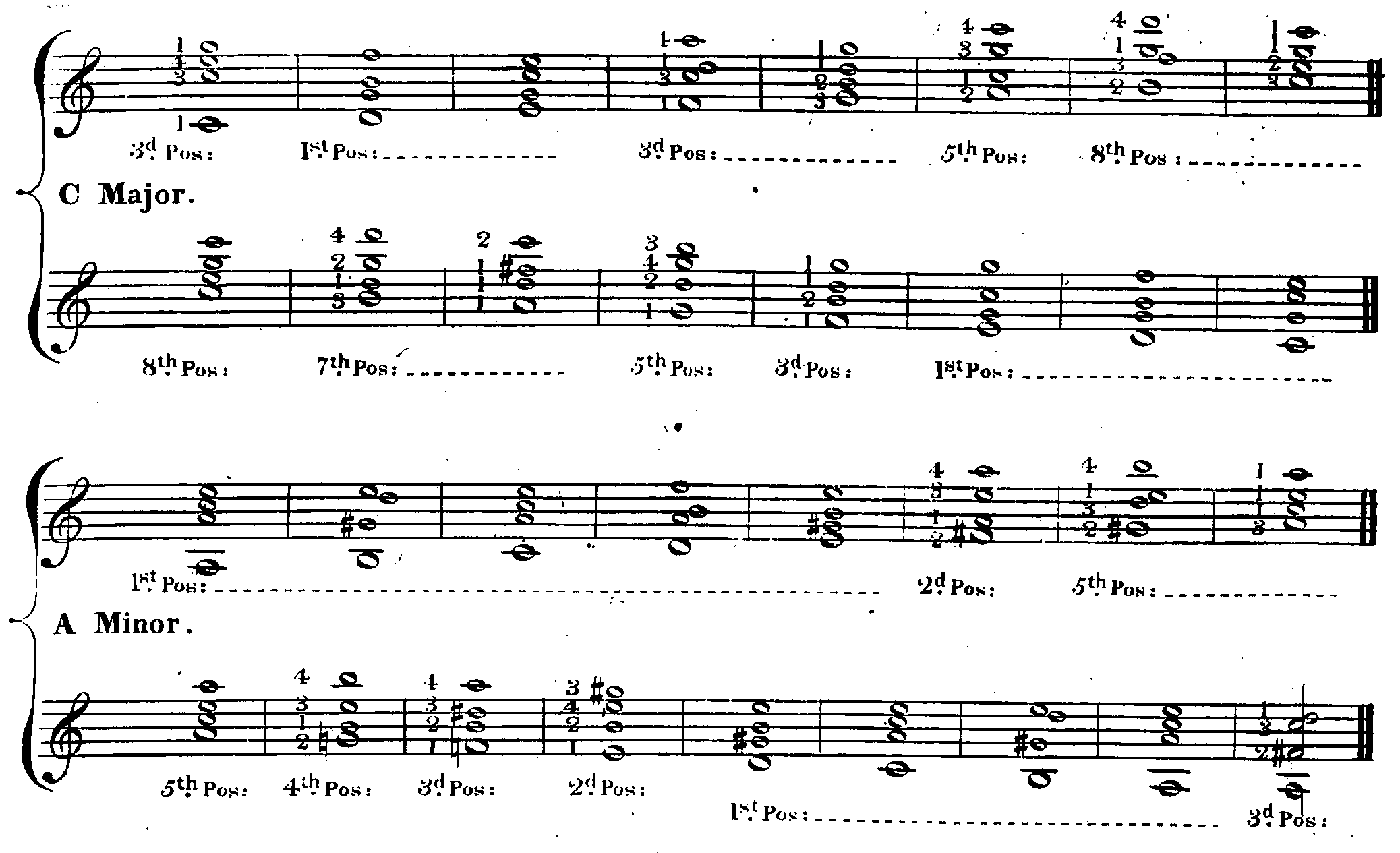
Kirkman’s harmonisation of the minor scale
➅ same harmonisation as ➅ in the major scale. Other than that, taking her different inversions into account, Kirkman is true to Fenaroli’s RO.
Fig. 4
Exercise on the Accompaniment of the Scale […] by Lousia Kirkman notated in partimento style.
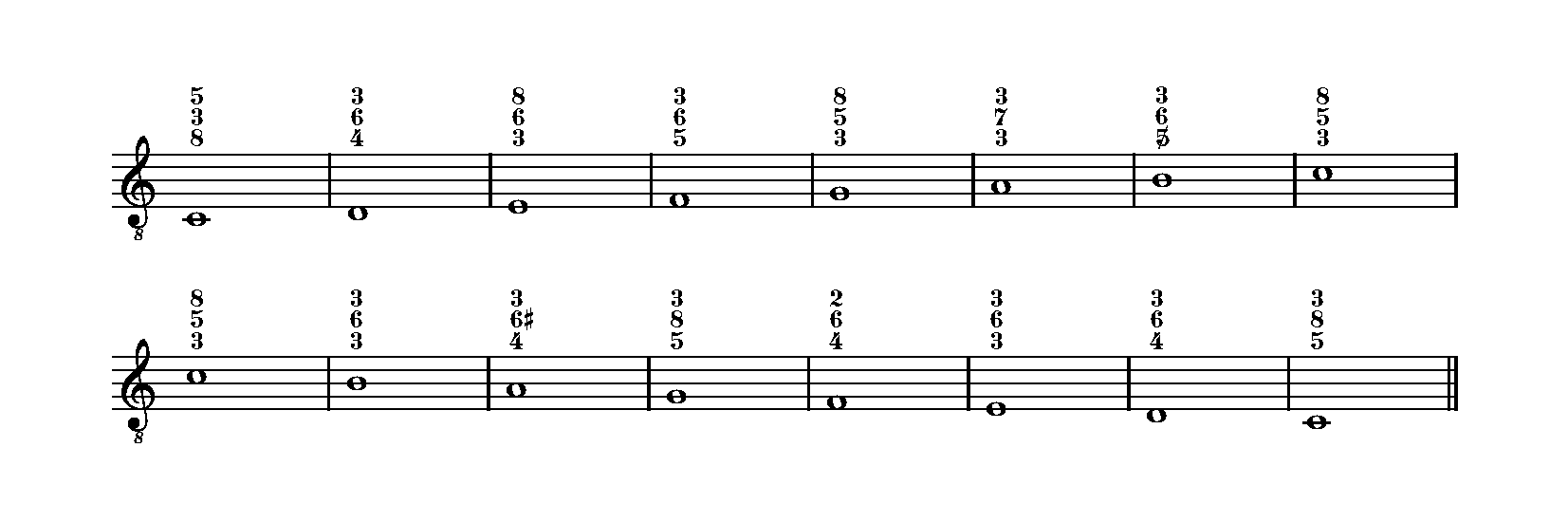
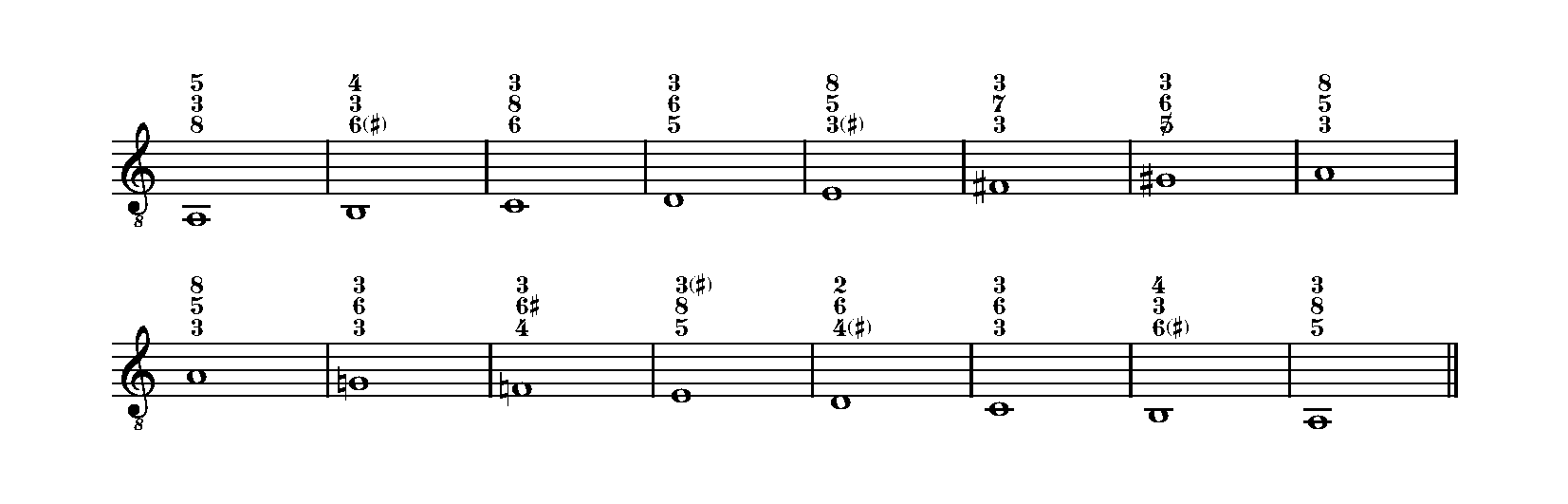
Fig. 5
Exercise on the Accompaniment of the Scale […] by Lousia Kirkman notated in partimento style.
Comment
If we compare Kirman’s version to the version of partimento master Stanislao Mattei in his Prattica d’accompagnamento sopra bassi numerati 1824, we can see many similarities. Especially the use of the 4 on the ➅ scale degree. Kirkman uses the same harmony as Mattei, but in an inversion more suited for the guitar. Compare fig. 5 and 6.
Fig. 6
Rule of the octave in a minor from Stanislao Mattei’s Prattica d’accompagnamento sopra bassi numerati 1824/1891.


Kirman’s exercise on the RO in all of the 24 keys can be found in her Improved Method for the Guitar […] pages 23-28.
The article continues on the next page...
 Karl Michelson