
A translation on the section on the De’ Movimenti del Partimento, or On the Movements of the Partimento in Fedele Fenaroli’s Partimenti ossia basso numerato, Book III, Naples (1775) Ed. Gjerdingen, with adaptions to the guitar.
On the Movements of the Partimento
In this essay, we will explore three characteristic melodic patterns described by Fedele Fenaroli in his 1775 treatise Partimenti ossia basso numerato. These melodic moves, foundational to the pedagogical tradition of partimento in the Neapolitan conservatories, illustrate essential voice-leading principles and how to apply counterpoint to an ascending major scale. We will further examine how these patterns can be effectively adapted for the guitar, considering the instrument’s tuning, range, and idiomatic possibilities.
When the partimento or major scale moves upward by steps, it can be accompanied in various ways:
I. 5th moving to a 6th:
Starting with the 3rd and 5th above ①, the 5th then moves up to a 6th. As the partimento rises stepwise, the 6th from the previous note becomes the 5th above the next note. This pattern continues as long as the stepwise motion persists, which can extend from ① all the way to ⑧.
Important: A 3rd should be present with every note in this progression.

II. 7th resolving to a 6th:
Beginning with the octave and 3rd above ①, the partimento moves up one step. Over this second note, the octave from ⑧ functions as a 7th, which then resolves down to a 6th. Afterward, the partimento rises a 3rd, placing the harmony on the octave of this new note. The stepwise rising continues in this manner as long as the motion persists, from ① to ⑧, assuming a major mode.

III. 9th prepared by a 3rd resolving to the octave:
Starting with the 3rd and 5th above the tonic ①, the partimento rises one step. Above this second note, the 3rd from ① is sustained as a 9th, which then resolves down to the octave. Next, it rises a 3rd to land on the 3rd of the new note. This pattern continues stepwise as long as the movement lasts, typically from ① up to ⑤.
Note: The 9th is accompanied by the 10th (also called the 3rd).
In the example given by Fenaroli, only the first third is tied. In strict style, the remaining suspensions should also be tied, but this can be challenging on the guitar. On certain scale degrees, sustaining the tie is physically impossible due to required string crossings. In such cases, a rearticulated suspension may be considered more idiomatic on the guitar

Fenaroli presents these contrapuntal motions exclusively within the major scales in the Partimenti ossia basso numerato. In contrast, the minor mode, as Job Ijzerman observes in Harmony, Counterpoint, Partimento, “requires some caution.” Ijzerman outlines two models for the minor mode: the first raises the sixth and seventh scale degrees in all voices, while the second employs the natural minor sixth and seventh on scale degrees ① and ②, but raises them on degree ④, ⑤, ⑥ and ⑦.
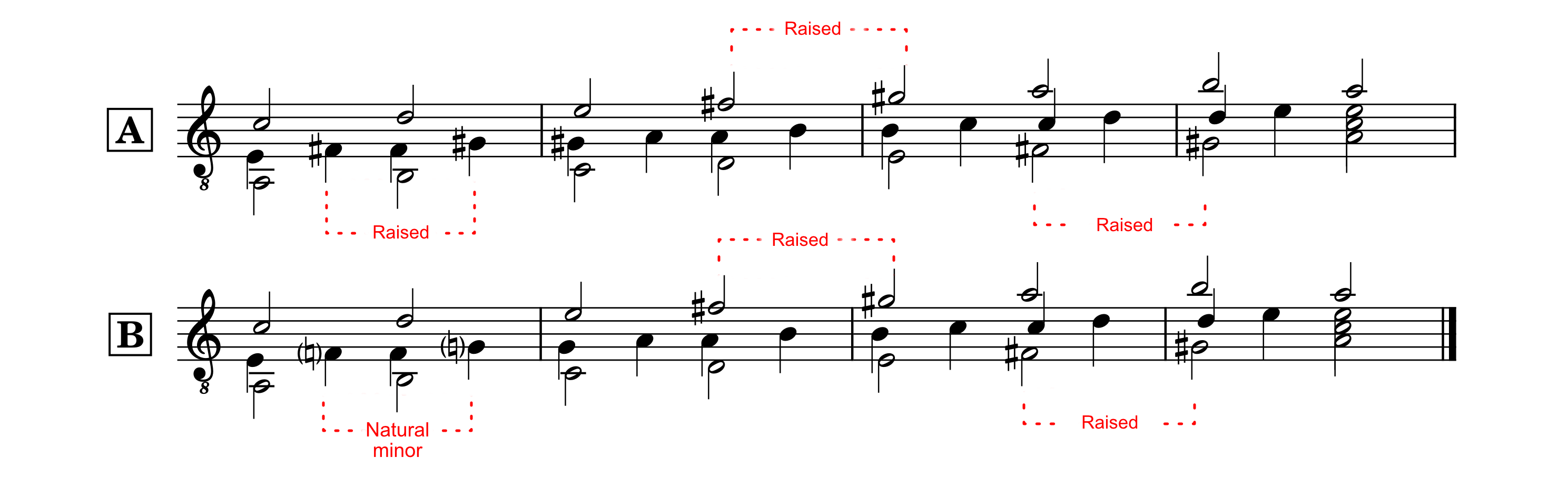
This essay will not discuss the minor versions of these movements any further, but will rather focus on the major modes, as presented by Fenaroli.
The following are three examples of each of the voice leading movements,
presented in sixteen different major key signatures.



This concludes this essay on the movements of the partimento.
You can download this essay as a PDF for free.
 Karl Michelson